Hyundai Is Booming in America and Slumping at Home
The three SUVs that carry Hyundai in America are losing buyers fast in South Korea.
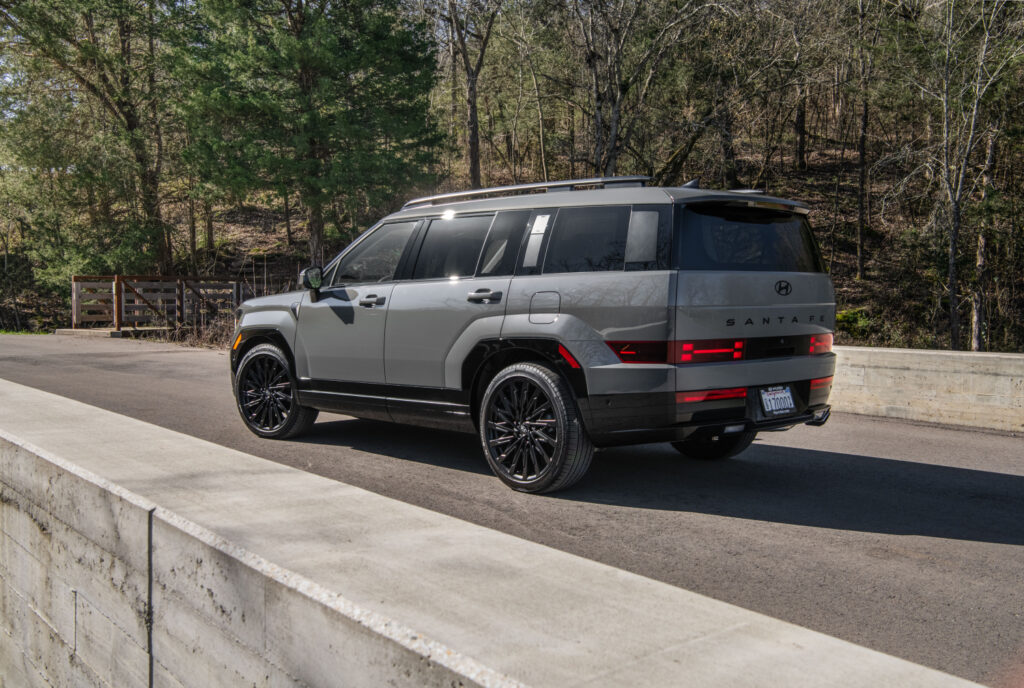
The three SUVs that carry Hyundai in America are losing buyers fast in South Korea. Over the first nine months of 2026, Koreans bought roughly two in five fewer Palisades than a year earlier, nearly as steep a fall for the Tucson, and almost a third fewer Santa Fes.
Those losses pulled Hyundai’s domestic total down 16.3 percent to 448,181, its weakest January-to-September showing in 18 years, back to the 2008 financial crisis. Worldwide the brand delivered 2.89 million, 7 percent fewer, and apart from pandemic-hit 2020 it had not been under the 3 million mark at this point since 2010. Kia even beat Hyundai and Genesis combined on Korean sales in October.
| Model | Korean sales, Jan.-Sept. 2026 | Change |
|---|---|---|
| Santa Fe | 31,146 | down 31.7% |
| Palisade | 26,989 | down 41.8% |
| Tucson | 24,209 | down 39% |
Those numbers were gathered in a Korea JoongAng Daily analysis published November 23. The paper’s main suspect is styling and price. Daeduk University professor Lee Ho-geun argued that Korean shoppers expect a tough-looking midsize SUV, that Hyundai’s latest Santa Fe ignored that, and that many of them went next door to the Kia Sorento instead. SUVs and minivans made up nearly two-thirds of Kia’s 140,522 Korean sales in the third quarter.
The electric side is going no better. Tesla’s sales in Korea had more than doubled by the end of October, up 105 percent, and its Model Y, imported from Shanghai, is second only to the Sorento on the country’s best-seller list with 78,631 sold. Kia moved 90,299 EVs on the strength of the cheaper EV3 and EV5, while Hyundai’s only new volume EV there has been the Ioniq 9. BYD is already the fourth-largest import brand.
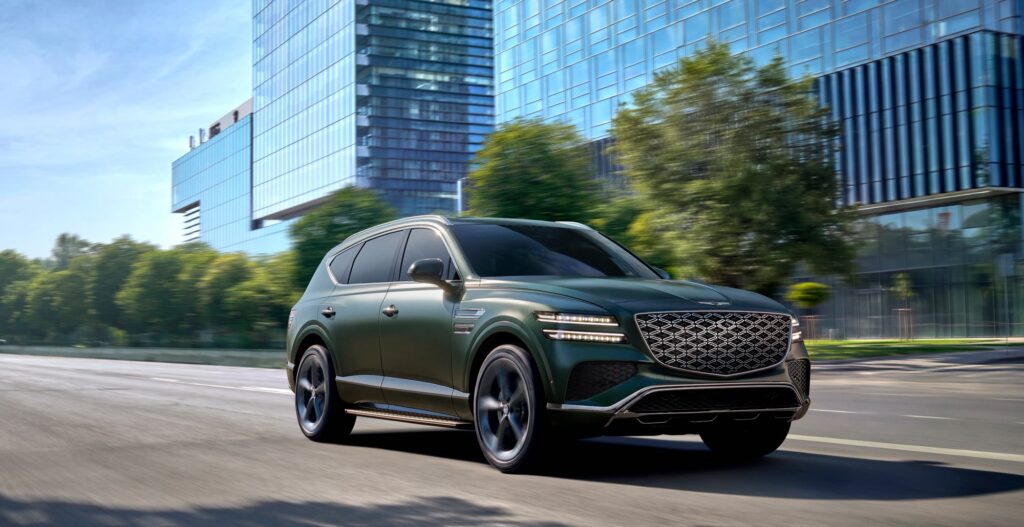
Genesis has its own problem with imported luxury cars. The brand lost 29.4 percent of its Korean volume through October, ending at 68,683, and its October number alone was down 34.4 percent. Import registrations tracked by the Korea Automobile Importers and Distributors Association moved the other way in October: Mercedes-Benz sold 6,744 cars for a gain of 15.5 percent, Lexus gained 9.8 percent, Volvo 17.2 percent, and Tesla’s 9,165 were more than double a year before. The G80 and GV70 have gone without a full redesign since 2020, and the GV90’s 200 million won price keeps it a halo car.
Hybrids are Hyundai’s answer. The GV80 went on sale as a hybrid in October, a hybrid G80 was revealed in Los Angeles on November 19, and a GV70 version is planned. Kim Chang-ho, who covers the company for Korea Investment and Securities, expects a better final quarter, with year-end buying adding to the new Tucson, the hybrid GV80 and the latest Avante as their output climbs.
The Avante, sold in the US as the Elantra, is the warning sign. Its opening quarter on sale produced less than half the volume the outgoing generation reached over the same span in 2020, and the new car carries a price roughly 3 million won higher, a gap Korean shoppers have already balked at. Hyundai’s own union sales committee wants prices reviewed because young first-time buyers are waiting. CEO Jose Munoz said at the August investor day that prices are set by the market and that Hyundai would adjust them if needed. The stock is down more than 60 percent from its June 2 peak of 787,000 won.
None of this has shown up in the US, where the brand’s recent growth has come from the Elantra and Tucson. Americans are getting the same redesigned Tucson and Elantra that Hyundai is counting on in Korea, and the hybrid G80 and GV80 are coming to US Genesis stores.
The HyundaiHQ Take
Hyundai’s home market used to be the safe base that funded its fights abroad. Now Kia is beating it on SUVs, Tesla is beating it on EVs and the German brands are beating Genesis on luxury, all on its own turf, and the common thread is a car that costs more without feeling like more.
That matters here because the new Elantra and Tucson are global cars. If the Korean Avante stumbled on price, the US Elantra will face the same test against the Corolla and Civic, and Hyundai has every reason to price it like the value car Americans have always bought rather than like a car with a captive market.
Related
Genesis Hybrids Pack V6 Torque Into a Four-Cylinder
Genesis is finally getting hybrids in America, and its first two pull as hard as its V6.
Genesis G80 Deals for November 2026: Leases From $609 a Month
Genesis is offering the 2027 Genesis G80 2.5T AWD on a lease from $609 a month and financing from 0.99% for 36 months on the 2027 Genesis G80…
2021-2026 Genesis Models Recalled Over Fuel Leak
In April 2026, Hyundai Motor America began recalling select 2021-2026 Genesis vehicles across 4 models over a potential fuel leak.
Comments (0)
Join the discussion