Kia’s American Pickup Is Already Testing Against the Tacoma
A development truck wearing a Kia Tasman body has been photographed testing in Southern California alongside a Toyota Tacoma, a Chevrolet Colorado and a Ram 1500.
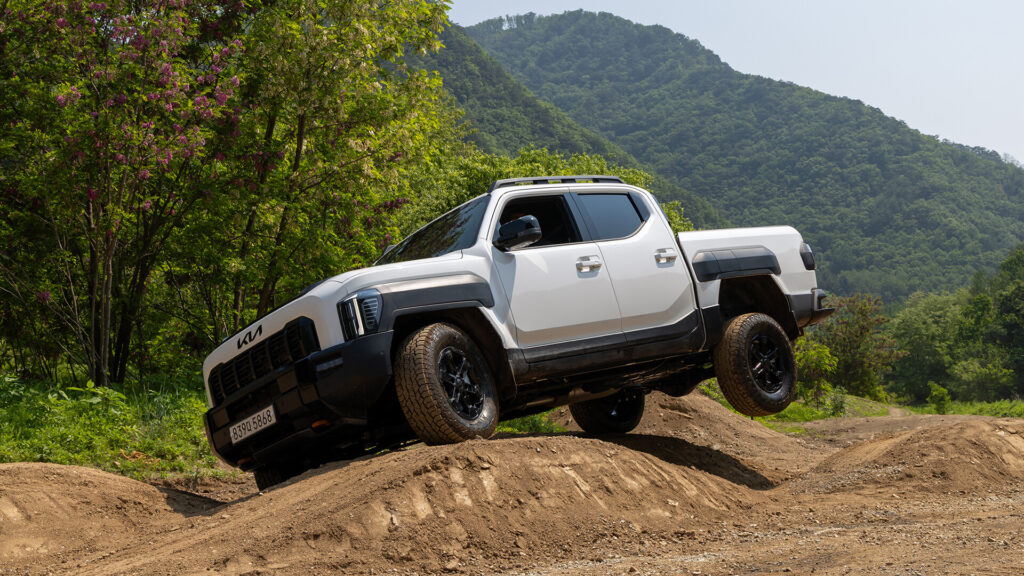
A development truck wearing a Kia Tasman body has been photographed testing in Southern California alongside a Toyota Tacoma, a Chevrolet Colorado and a Ram 1500. The hardware under its fender flares does not match any Tasman Kia sells, and the wider track, the aluminum front suspension arms and a rear axle located by a Panhard bar all point to the body-on-frame pickup Kia has promised for North America before the end of the decade.
Kia confirmed in April that it will enter the US pickup segment with a body-on-frame truck offered in hybrid and range-extender electric versions, and that it will launch by 2030. It has not shown the truck, named it, given it a price or said where it will be built, so a prototype running benchmark tests against the segment’s best sellers is the first physical evidence that the program is moving.
CarBuzz published the spy photos on November 6, describing what it called an organized development session in which drivers rotated through the Kia and its three rivals. The outlet noted that Ford was absent, and reasoned that Kia already sells the Tasman in markets where the Ranger competes, so it has no need to benchmark that truck again. Kia has not commented on the photographs, and the truck’s identity is CarBuzz’s reading of the evidence rather than anything the company has confirmed.
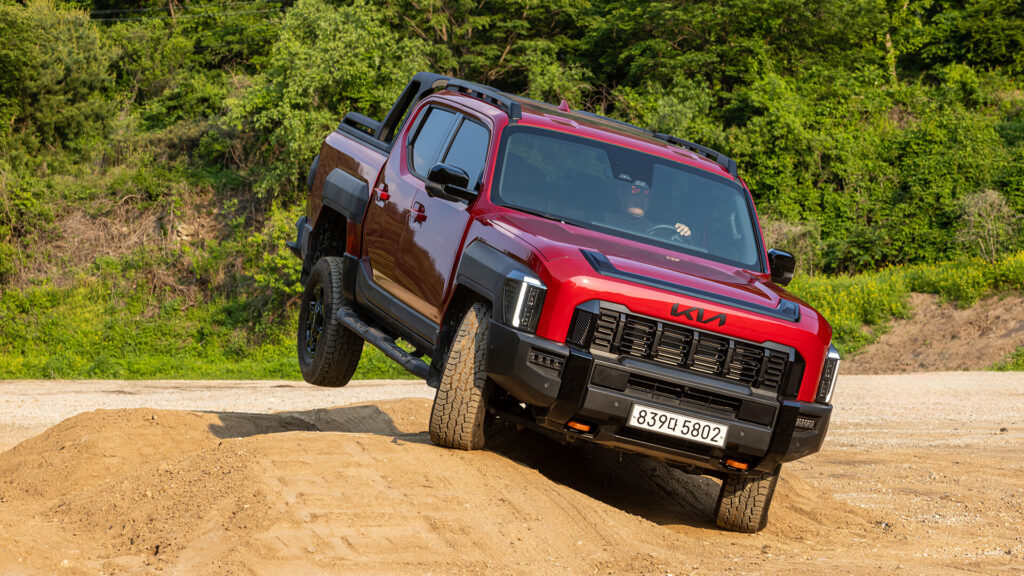
That evidence is fairly specific. The wheel arch extensions are much larger than the Australian-market Tasman’s and stand well clear of the body, and the tires are 10 millimeters wider than anything Kia offers on the Tasman, which together give the truck a wider track. At the back, the outlet spotted a Panhard bar, an anti-roll bar and trailing arms, where the Tasman uses a solid axle on leaf springs with a pair of shocks. The front lower control arms are aluminum rather than the Tasman’s black-painted stamped steel. The wheels carry the code TV, while Kia’s internal code for the Tasman ends in K rather than V.
The official plan behind the prototype came out of Kia’s CEO Investor Day in Seoul on April 9, where the company’s strategy for the United States listed "entering the pickup truck segment" and the product roadmap read "launch body on frame pickup truck with HEV, EREV variants by 2030," according to the summary posted by Hyundai Motor Group. The same plan grows Kia’s US hybrid lineup from four models to eight and targets 4.13 million global sales by 2030. The group’s summary says the Tasman, which launched last year, went to global emerging markets rather than North America. WardsAuto reported at the time that Kia said the US truck would not be a version of the Tasman and that the pickup is meant to be one of the centerpieces of Kia’s US sales growth by 2030.
A Tasman-bodied mule with different suspension and a different model code fits that description. The Tasman is Kia’s first pickup and is sold in Korea, Australia, Africa and the Middle East, with four-wheel drive standard on its X-Line and X-Pro grades, and it is not sold in the United States. The American truck would be the first body-on-frame pickup from Hyundai Motor Group in this market, where Hyundai’s Santa Cruz is a unibody pickup built on a crossover platform.
CarBuzz put the midsize body-on-frame market at close to 600,000 trucks a year, with Toyota taking nearly half of it with the Tacoma, and it argued that the truck will have to be built in the United States, Mexico or Canada to avoid heavy tariffs. That is the outlet’s reasoning rather than a Kia decision, and the company has not named a plant.
The HyundaiHQ Take
Benchmarking against the Tacoma, the Colorado and a half-ton Ram in the same session says Kia is still deciding exactly how big and how tough this truck needs to be, and the coil-sprung rear end with a Panhard bar suggests it is aiming at ride and handling rather than the leaf-sprung work-truck end of the segment. The hybrid and range-extender powertrains Kia promised would give it a story to tell against the Colorado and the Ranger, but the clock is running: a truck arriving in 2029 enters a segment that will have had three more years of Tacoma, Ranger and Colorado updates. The test mule proves the program is real. The plant decision, which Kia has not made public, will say whether it can be priced to compete.
Related
Hyundai Sonata Deals for November 2026: Leases From $279 a Month
Hyundai is offering the 2026 Hyundai Sonata SE on a lease from $279 a month and financing from 1.9% for 60 months on the 2026 Hyundai Sonata this…

Hyundai’s Robotaxi Gets Half the Range of a Retail Ioniq 5
The 2027 Hyundai Ioniq 5 Robotaxi is rated at 168 miles of range, a little more than half of what the rear-drive Ioniq 5 at dealers can go.
Kia’s Seltos Hybrid Rates 43 MPG Before It Even Has a Price
The 2027 Kia Seltos Hybrid is rated at 43 mpg combined with front-wheel drive and 40 with all-wheel drive, and Kia still has not said what it costs.
Comments (0)
Join the discussion